Journal · black soap
Black Soap and the Kessa Glove: The Scrub Step Explained
· 4 min read
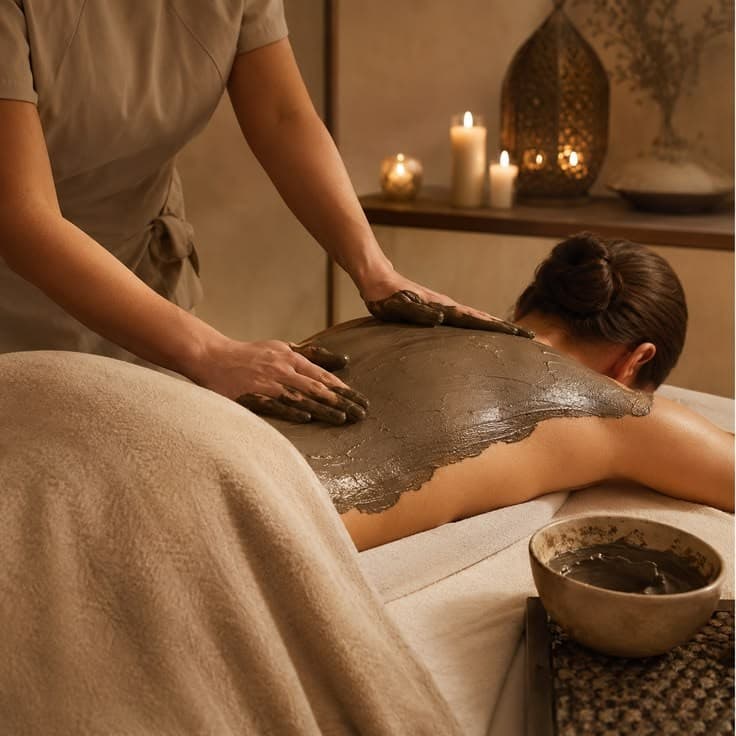
The scrub is the part of a hammam that surprises people most. You arrive expecting to feel relaxed, and someone hands you a rough glove and a jar of dark paste. It looks strange, and the first time it can feel strange too.
Then you rinse off, touch your arm and wonder why your skin has never felt like this before. Here is what is actually happening.
What black soap is
Savon beldi, often just called black soap, is a soft soap made from olives. The colour is a deep brown or dark olive, and the texture is sticky and gel-like, closer to a thick balm than a bar. Some versions are scented with eucalyptus, which gives a fresh, clean smell.
It has been used in Moroccan homes and hammams for a very long time, and it is simple on purpose. Shampoo cleans hair. Black soap has a smaller job, which is to soften the top layer of skin so it is ready to be removed.
How it is used
The soap is spread over damp skin, usually after you have spent some time in the warm room. Then you wait, typically five to ten minutes. The heat and the soap work together, and the skin becomes noticeably softer. This waiting is the most important part, and it is also the part people try to skip.
If the soap is rinsed too early, the scrub feels rough. If it is left to do its work, the scrub feels almost easy.
What the kessa is
The kessa is a mitt made of coarse woven fabric. It fits over the hand, a bit like an oven glove, and it is rougher than a normal washcloth. Traditionally every family had one, and many people still take their own to the hammam.
It is the simplest tool imaginable, and it is surprisingly effective. A cloth or a loofah will not give you the same result, because the weave of the glove grips the loosened skin instead of sliding over it.
What you will see
With firm, even strokes, the glove lifts away dead skin cells. They gather into tiny grey rolls on the surface, and the first time you see them it can be a little startling. This is ordinary skin that was ready to leave.
Most first-time visitors laugh at this point. Almost all of them admit afterwards that their skin has never felt smoother.
It should not hurt
A good kessa is firm but never painful. The strokes follow the length of the limbs, move at a steady pace and stay away from skin that is red or irritated. If something stings, say so. A lighter touch will give you nearly the same result.
If you have sensitive skin, a skin condition or a recent sunburn, skip the scrub or ask for a very gentle one. Cuts, broken skin and fresh waxing are also reasons to wait. We always ask before we begin, and we always respect the answer.
How often to do it
Once every week or two is plenty for most people. Doing it more often will make you red, tight and unhappy instead of smoother. Skin renews itself on its own schedule, and the kessa only helps what is already ready to go.
What comes next
Right after the scrub, the skin is clean and slightly open. That is when it takes in oil and moisture best. In a hammam, this is the moment for argan oil and rose water.
If you scrub and do nothing afterwards, your skin may feel tight within an hour. If you follow with oil, it can stay soft well into the next day.
The ritual around the product
You can buy black soap and a kessa online and use them at home. Many people do, and it works. But something is lost when you do it alone in a hurry, because the ritual is slow on purpose.
The warm room, the waiting and the careful strokes matter as much as the soap.
In our studio
Our rituals in Bassano del Grappa follow this order: warmth, black soap, scrub, rinse, oil, then rest. We take it slowly and check in with you at each step, because nobody should have to guess whether the pressure is right.
If you are curious but a little nervous about the scrub, tell us when you arrive. We will explain every step before we begin, and we can adjust the pressure to suit you.