Journal · hammam
What Happens in a Moroccan Hammam, Step by Step
· 4 min read
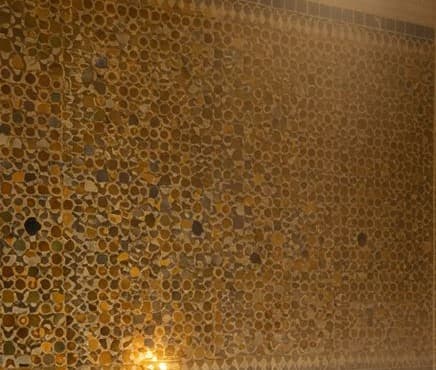
Ask a Moroccan woman about her first hammam and she will usually smile before she answers. For many of us it is a childhood memory: a mother or grandmother carrying a bucket and a bag of towels, a short walk through warm streets, and then a door that opens onto steam.
Our founder, Iman, remembers going to the hammam with her mother when she was small. She cannot recall what they said to each other. She remembers how she felt afterwards, which was light, safe and looked after. That feeling is the reason L'Incanto Di Iman exists, so it makes sense to begin our journal with the ritual itself.
A neighbourhood tradition
The hammam has been part of Moroccan towns for centuries. Its roots are usually traced to the Roman bathhouses and to the Islamic custom of washing before prayer, and over time it became something of its own. Almost every neighbourhood had one, often next to the bakery and the mosque. Women and men go at different hours, and a visit can take most of an afternoon.
It is also a social place. People talk, laugh, help each other scrub hard-to-reach spots and share news. Brides go before their weddings, and friends go together just because it is Friday.
Step one: the warm room
A hammam is built around heat and moisture. You start in a warm room, then move to a hotter one, and your body slowly gives in. Skin softens, breathing deepens and muscles stop holding on so tightly. Most people say the first ten minutes are about doing nothing at all, and that is the point.
Step two: the black soap
Next comes savon beldi, the soft black soap made from olives. It is spread over damp skin and left to sit for a few minutes while the steam does its work. The texture is closer to a paste than a bar, and the smell is deep and earthy.
The soap loosens the top layer of skin so the next step is gentle instead of rough.
Step three: the kessa
The kessa is a coarse glove, and it is the part of the ritual people remember. With firm, even strokes it lifts away dead skin, which appears as small grey rolls. First-time visitors are often surprised by how much comes off, and then by how smooth their skin feels afterwards.
Done well, it never hurts. If your skin is sensitive, ask for a lighter touch.
Step four: rinsing
Warm water is poured over the body, slowly and generously, usually from a small bucket. Many women describe this as the moment the day's tension leaves with the soap.
Step five: oil and rose water
Once the skin is clean and still warm, it is ready to absorb. This is where argan oil comes in, rubbed over the arms, legs and shoulders. Rose water follows, often on the face, to cool and refresh. The skin stays soft for hours.
Step six: tea and rest
No hammam visit ends at the door. There is mint tea, a seat in a cool corner and a quiet half hour while the body settles. Rushing straight back to work undoes much of what the heat and water just did.
What we took from it
At L'Incanto Di Iman we are not a public bathhouse, and we do not pretend to be one. Our studio in Bassano del Grappa welcomes one guest at a time, in one room, with a Moroccan mosaic arch at the centre of it. What we borrowed from the hammam is its order and its spirit: warmth first, then cleansing, then oil, then rest, and nobody watching the clock.
Our rituals follow the same arc Iman knew as a child: a moment to let go, a moment of renewal, a pause for stillness and a long surrender into the massage.
Why it still matters
Most of us spend our days giving attention to other people, to screens and to deadlines. A hammam asks only for your presence, and for a few hours you are a body in warm water being cared for.
You do not need to be Moroccan to feel that. You only need to be tired in the ordinary way most of us are, and willing to let someone else take over for a while.
If you would like to know more about our rituals, you can read about them on our website or write to us directly. We are happy to talk you through what to expect.